3G icon does not display on Telstra iPhone – no internet access

My son’s been moaning something about no 3G access on his Telstra iPhone for the last week or so, finally sat down to look today. He was right – the signal strength is fine, but no ‘3G’ symbol. And if you try to open a web site in the browser you see a ‘no internet access’ message.

I hunted around online and finally found this forum post. One of the remedies suggested is:

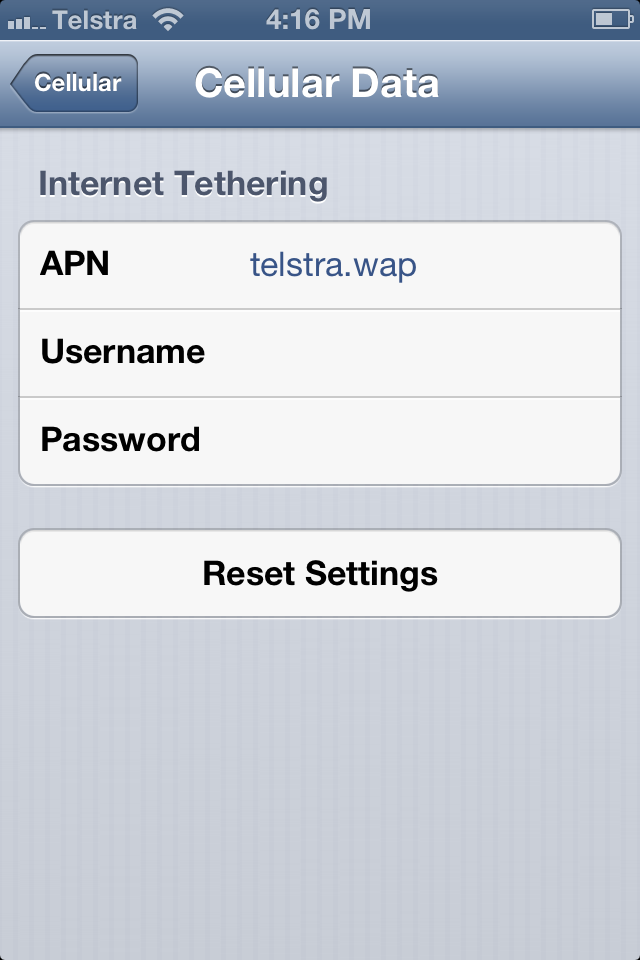
“go to settings – general – cellular – Cellular data network -and change APN from telstra.wap to telstra.iph”

I checked the settings and lo and behold:

telstra_wap

I changed the setting to telstra.iph:

telstra_iph

…then rebooted the phone. Now have the 3G symbol displayed, and data access when not connected to our wifi.

Son now much less grumpy with me.


Piss off affiliate marketers (how come you all live in Thailand?)

uncle-scam

Man I hate these people – yet they like following my blog (really need to figure out why I attract these dicks).

So I see two new blog followers in one day:

How nice someone cares about the rubbish I write, excited I go and check out their web sites. And guess what, both are plugging an affiliate program called Project A.W.O.L. It’s your typical cut and paste with a bit of re-writing to make it seem different.

Joe says:

So I have been getting a lot of questions from people about how I can afford to do so much travelling, or how I have so much time to actually do the things I enjoy in life.

Julian says:

So lately Iv’e been getting a ton of questions from people asking me how I can afford to live a lifestyle by design, travel the world, and have the freedom to do the things I love, with the people I love, by only using my laptop and an internet connection.

Joe says:

The reason why I can travel or do all these things without living on a shoestring budget is because I’m earning my income online from blogging and affiliate marketing.

Julian says:

The reason why I can afford to do all of the things I love without living paycheck to paycheck is because I’m earning my full-time income from affiliate marketing and blogging on the internet.

Previously of course they only shared the secret of their success with close friends, but now they’ve decided they want everyone to be rich.

It’s all lies, and so easily unravelled, even just casually looking at clearly faked income statements.

Joe:

joe

Julian:

julian

Gee, what a coincidence, they both earned EXACTLY THE SAME INCOME for a particular day, we just decided to change the month.

A bit of a Google finds this piece of rubbish with a video:

Screen Shot 2013-06-05 at 2.58.16 PM

His name is ‘Tom’ and he’s ‘coming to you from his house in Thailand’. Which is interesting because Julian just had a fabulous holiday at a rental house in Thailand.

What we had lined up because of the connections and magnitude of the vision that Kam and Glenn have…is that we rented out a $50k/month hillside mansion in Phuket Thailand complete with personal chefs, chauffeurs, yachts, excursions and here’s the best part

…wait for it!

$140,000/month Hollywood film crew filming every single bit of it!

Another coincidence!

Ooh look, Dakota McLean just retired and moved to Thailand thanks to Project A.W.O.L.

Screen Shot 2013-06-05 at 3.14.15 PM

Honestly couldn’t be bothered chasing down any more of this crap.

Sigh.

I need to write more blog posts about SQL server and missing toolbars in Excel

Dilbert.com

I have absolutely no plan or strategy for my blog, it’s purely an entertainment and I write about whatever happens to be on my mind at the time – usually something I’ve seen or heard during the day, or encountered in my normal working life. I also tend to be something of a help desk for all sorts of contacts, plus I provide 24/7 tech support to my own household and extended family, an unpaid gig I need to point out (that’ll change come the revolution).

As a consequence I pay virtually no attention to any of my blog statistics, visitors, who reads what etc – because to be honest it’s not relevant.

Last October I moved my blog from Typepad to WordPress, and WordPress has a much, much better statistics system in-built, so I noticed I could easily check a list of the most read stories, here are the top 10:

Looping through records in SQL Server Stored Procedure 1,671
Missing Formula Bar in Excel (for Mac) 964
ASP Timeout expired error: Microsoft OLE DB Provider for SQL Server error ’80040e31′ 888
Solving ‘Login timeout expired’ Problem on Windows Server 2008 419
Drag and Drop stops working on Mac Lion 163
How to host IIS7 web site on Mac OSX folder via Parallels 128
Cricket Scoring Signals and Symbols 103
No honey, actually it’s NOT my speeding fine. Google Location History – bit creepy, pretty useful 82
SQL Server mqSQL “Commands out of sync; you can’t run this command now” 66
How to refresh Facebook’s cache of your blog post when you update 55

The problem is, if I followed traditional blogger convention I should be analysing all this and zeroing in on what my audience wants. Apparently, people REALLY want to know how to loop through a set of records in a SQL Server stored procedure (you know you want to as well….). And a way to recover a missing toolbar in a now old version of Excel.

I hate to disappoint you, but the reason I write most of these more ‘geeky’ posts is actually to act as a reminder for me, so the next time I encounter the issue I can look back and check how I solved the problem last time – kind of my own knowledge base you might say.

How to syncronise bookmarks across different browsers on your computer

bookmark

This is a perennial problem for me, I often have multiple browers open – Firefox, Safari, and Chrome on my Mac, Internet Explorer in Windows (via Parallels), often because I need to be logged into the same website as different logins; or because I’m testing browser compatibility.

Chrome is my default browser – a major change I made a while back after Firefox just became too slow, although I still use it for debugging because of the indispensable Firebug.

I have several bookmark folders with lists of web site addresses I access constantly. But of course that’s in Chrome, so when I open up another browser I have to go back to Chrome, grab the URL, and paste it into the new window. All a bit tedious. Once or twice I’ve exported my bookmarks out of Chrome and imported them into the other browsers, but that’s not much chop as a plan.

The other day I came across Xmarks, software designed to keep your bookmarks in sync across all your browsers and devices (eg your computer, tablet, phone and so forth). I’ve installed the software in all my browsers, and it quietly syncs my bookmarks. If I add a bookmark in one browser, after a while it turns up in the other browsers – or if I’m impatient I can manually trigger a synchronisation.

I love tools like this, it might not be a problem for everyone, but for those of us who do need this functionality, Xmarks is the perfect solution.

Image: Enokson

Video: Wangaratta beer fridge animation

I received a lovely email overnight from the guys at TomoNews US – they’re part of Next Media Animation, the company that makes the fun Taiwanese animations.

They noticed my blog post about the beer fridge in Wangaratta interferring with the mobile phone network, they’ve made a cute video about the story!

Enjoy!

How a beer fridge caused widespread mobile phone blackouts

beer-fridge


UPDATE:  The guys at TomoNews US have made a cute video about the story!

I’m an avid follower of what I term ‘fragile technology’ stories – and so the idea a beer fridge could cause mobile phone network interference across parts of Wangaratta is fabulous.

Apparently residents in Wangaratta have been experiencing mobile phone network problems for some time. Telstra’s technicians using software tools and then hand-held antennas finally tracked the interference to a beer fridge in a man’s garage.

The fridge is believed to have been interrupting mobile signals in “several neighbourhoods” of the town of 17,000, which lies about 230km from Melbourne.

There’s some discrepancy in the reports as to exactly what part of the fridge caused the interference – one says it was the light globe, another the fridge motor. Apparently nobody is blaming the beer – obviously a major relief for anyone who enjoys a cold beer whilst chatting on their phone.

What is more alarming is the confession by Telstra that the list of devices that can possible intefere with the cellular network is long:

Telstra engineers say any electric spark of a large enough magnitude can generate radio frequency noise that is wide enough to create blackouts on the 850mHz spectrum that carries our mobile voice calls and internet data.

Lamps, TVs, and electronic signs are a problem:

Mr Jennings says an “enormous range” of rogue appliances can cause disruptions. There’s things called mercury vapour lamps which are often used in retail premises, domestic TV installations is a big one, even large electronic advertising signs can cause interference,” he said.

It also seems there’s a big issue with illegal mobile repeaters – to the point I’m wondering how come I don’t have one in my backyard to help out Fiona (who still staggers along with the terrible Vodafone coverage for her iPhone).

“There’s probably a vast number out there that just don’t show up in our network stats but still have some impact on the network.”

Seems there’s a bunch of dodgy web sites out there selling these boosters, including ones specifically targeting us poor Australian saps. Although the idea of going to jail for a zillion years for using a repeater may just dissuade me.

Image:  Simon Lieschke

No honey, actually it’s NOT my speeding fine. Google Location History – bit creepy, pretty useful

google-latitude-cell-phone-tracker

I’ve just discovered the Google Location History page for my account, that tracks where I’ve been, based on my iPhone pinging Google on a regular basis. I can’t work out whether to be completely creeped out, or to shiver with excitement with all the ideas welling up around what useful applications you could build around the data. It’s actually been around for a while, it’s part of the Google Latitude product.

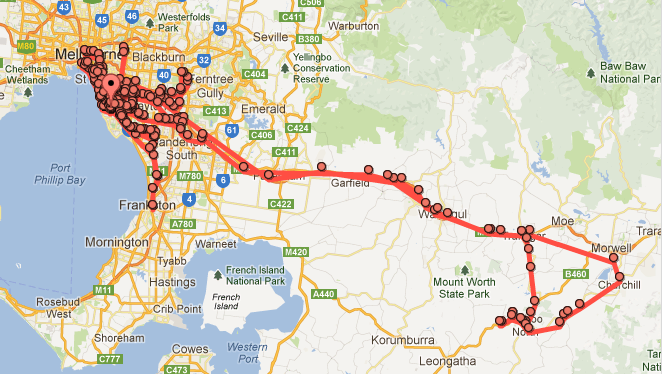
Here’s my map for the past 30 days:

Screen Shot 2013-05-28 at 5.37.03 PM

Big concentration of dots around the David HQ in Brighton. Couple of trips up to the northern suburbs (that’ll be sports games with my son); and a big trip down to the south east of Victoria, when we had a delightful day in the country, including stopping by the snail farm for some escargot.

Before you panic, this page is only available to you, not publicly, and you can delete the history at any time. To reach all this goodness, log into your Google Location History page. It’s possible to invite friends to access your Latitude data as well.

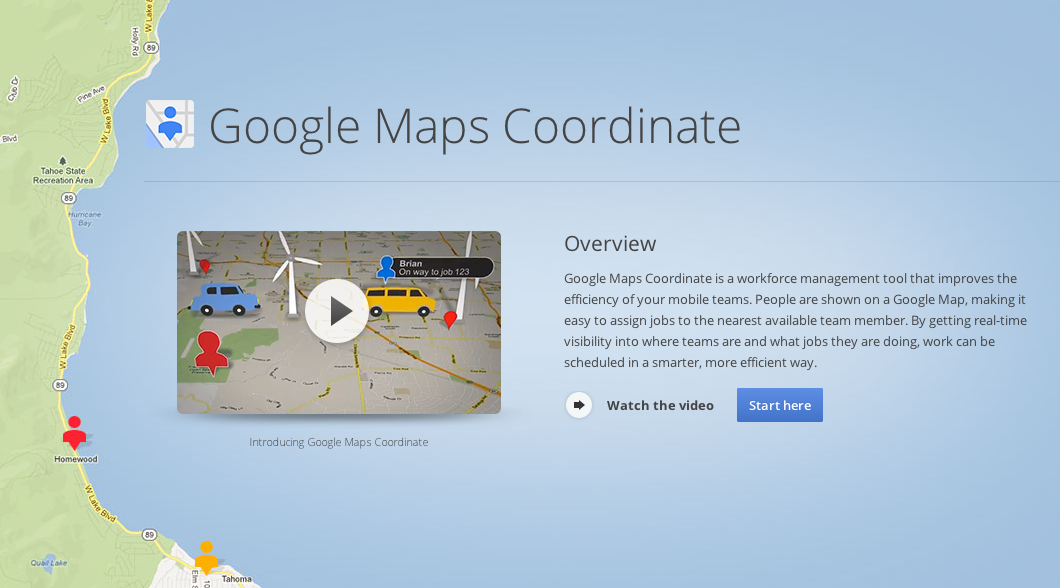
It had not struck me until I searched around a little, but an obvious application for this data is tracking company employees and assets. For example, Google has their own service via Google Maps for Business.

Screen Shot 2013-05-28 at 5.47.55 PM

Clearly there are security and privacy concerns around this data. It’s a little strange seeing my travels mapped with such accuracy. And of course there are the positive tales, like stolen property being recovered using Latitude data.

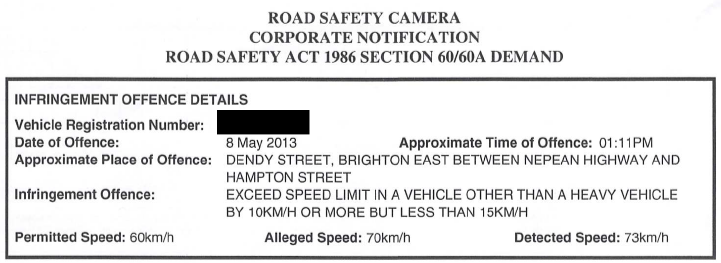
However, here’s the really neat stuff, look what turned up in our mail today:

speed-fine

Yes, oops. Someone was a little over the speed limit earlier this month, there was some debate in our household who this might have been, neither of us could recall who was out and about on Dendy Street at lunchtime on 8 May. I decided to fall on my sword and sign the form and accept responsibility – and the demerit points.

But now I’ve checked Google Latitude, here’s my map for the day:

dendy-street

Dendy Street is up the top – I never went near there, at least not with my iPhone in my pocket, and it’s a rare time I leave the house without my phone. Not sure this is worth broaching with @FionaK, so I’ll cop to the fine anyway.

I’m liking my 40 times faster internet access – please don’t cap me at 25Mbps Mr Abbott

1billion-miles-per-hour

A nice man from BigPond turned up today and installed cable internet for us, so we now have both cable and ADSL internet connected at home. I’ve been running tests using speedtest.net and the difference is remarkable.

Our ADSL is supposed to be ADSL2+, the fastest available, here’s our speed test result (with my Mac connected via ethernet).

bigpond-adsl

And here’s the cable result (with my Mac connected via wi-fi, not even ethernet).

bigpond-cable

The iPads are running around 40Mbps, iPhones around 17Mbps, not quite sure why the phones are a little slower, but to be frank it’s still a lightyear improvement.

The gamers, YouTubers, Apple TVers and other bandwidth sucks in my house are going be like pigs in clover.

Oh, and just to make the political point – I for one am not interested in the slightest at the idea of a maximum of 25Mbps as proposed by the Liberal opposition. Even if my cynicism about the TV lobby is unfounded. Let’s do a count of what devices are online right now (I can hear some of them from my study), by my reckoning:

  • 3 iPhones (including me checking Twitter to avoid working)
  • 3 Macs (including me trying to get some work done)
  • 2 iPads (I hear at least one playing Hi-5 YouTube clips)
  • Playstation with Call of Duty in full battle

And this is a lighter than normal load, our eldest daughter, one of the major net consumers, is not here. Whilst there’s no question we are a geeky household, nobody can tell me we are particularly out of the ordinary these days. Why on earth you would introduce such a low ‘cap’ on the nation’s ability to access the internet is beyond me.

Image: jpctalbot

So Yahoo is buying Tumblr – apparently it’s a terrible idea and a good idea

tumblr-yahoo

I’m really only mildly interested in the news Yahoo is buying Tumblr, although I like the purchase price of $1.1b because it means my flickering hope of striking rich is still alive, just have to find the right idea.

What has interested me is the coverage in the media. Because depending on which commentary you read it’s either a genius move, or a damned stupid one. Yahoo kind of set the trend by promising not to stuff up:

“Per the agreement and our promise not to screw it up, Tumblr will be independently operated as a separate business”

And off we go…

“paying $1.1 billion for a company with $13 million in revenue seems a little nuts to me”.

Roger Kay at Endpoint Technologies

Tumblr generated about $13 million of revenue last year. It also, presumably, lost money. Some pundits glance at these numbers and conclude that obviously the Tumblr deal is just yet another hallucination by idiot managers who don’t understand that they’re paying good money for nothing…..These criticisms are silly.

 on the Yahoo Finance site

Tumblr faces a fundamental problem that starkly differentiates it from Facebook and Twitter. It will probably never grow as larger as either rival, having long catered to an audience of artists and creative types that limit its base to hundreds of millions of people, not billions.

Abram Brown on Forbes.com

To both make money off of Tumblr while not infecting it with the company’s anodyne reputation will be a huge challenge. Here’s hoping Yahoo actually doesn’t screw it up.

Joe Brown on wired.com

One has to applaud Marrisa Mayer’s “go big or go home” move and the notion that Yahoo’s board is standing behind this purchase will (reportedly) full support. A successful integration of Tumblr into Yahoo’s forward-looking strategy could end a losing streak of purchases and fizzled launches which includes Maven Networks and Geocities as well as Livestand and Yahoo 360.

Allen Weiner on businessspectator.com.au

“the more I look at this tie-up, the more it makes sense to me”

Felix Salmon, Reuters

Tumblr’s users are almost universally unhappy with the news that the site might get sold to Yahoo. And they may let their fingers do the talking, and the walking.

Ingrid Lunden on TechCrunch

I give up. I have no idea whether this is a good idea or a bad idea.

Could the Liberal Party’s opposition to the NBN be in part driven by TV broadcast lobby?

google-fiber

Google has been rolling out its Google Fiber internet connections in communities in the USA. Google Fiber offers a 1Gb internet service for $US70 a month, $US120 including tv channels. It’s basically akin to a Foxtel cable connection to your home, but with blisteringly fast internet.

An article on the Forbes website caught my eye this morning “Online Video Soars As Traditional Broadcast Collapses“. Apparently in areas where Google Fiber is available video on demand services delivered over the internet are booming, and traditional broadcasters are suffering badly:

Demand for VOD is growing even more quickly than analysts expected, as traditional broadcast audiences shrink and the market for traditional broadcast content implodes. As consumers spend increasingly more time on their mobile devices, revenue from broadcast advertising has suffered. Broadcasters have cancelled 18 programs from the 2012-2013 season so far, according to Entertainment Weekly.

Also interesting is how it’s spurring other internet providers to take action:

Google Fiber’s influence is impacting other carriers as well: within a week of Google’s announcement of expansion to Austin, Texas, AT&T announced a 1 Gbps plan for Austin and Time Warner Cable  announced new city-wide wireless service for its Austin customers.

In Australia we’re staring down the gun barrel of a change of government, to a Liberal party that wants to neuter many of the benefits of the National Broadband Network, the Labor Government’s plan to install fibre to the home internet – and which is already up and running in some suburbs.

The simplest way to express the difference between Labor and Liberal is speed. Because the Liberal plan does not delivery a fiber connection to your home (or business premise), instead replying on a ‘last mile’ of copper or wi-fi, inevitably speed is comprised. Tony Abbot is on record as saying that 25Mb is “is going to be enough, more than enough, for the average household”. If you want the full 1Gb potential you’ll have to pay for the fiber to be extended to your home. In contrast the NBN brings the fiber directly into your home, just like your pay TV cable.

The Liberal’s argue their plan is cheaper and better. The problem is almost no expert or commentator seems to agree with them, based on my probably biased survey of news stories.

Their policy is all the more stranger because the person in the driving seat is Malcolm Turnball, the Shadow Minister for Communications. Malcolm made his considerable fortune from innovation online – especially as one of the early backers of pioneering Australian internet company Ozemail. I’ve long been fascinated at Malcolm’s opposition to the NBN, it just seemed against what surely must be his past experiences of how innovation in internet connectivity can stimulate a community and economy.

The Forbes article piqued my interest. The local television broadcast companies have long been loud and effective lobbyists in Canberra. Their mega-rich owners always happy wheel and deal – and on occasion threaten and cajole – our politicians. And traditionally they’ve opposed innovation and competition in their very lucrative,

So it made me wonder if the broadcasters have been reading the tea leaves and realising just how much of a threat the NBN poses to their cosy oligopoly – and whispering in the ears of the Liberal party power brokers? Rupert Murdoch, who owns a serious chunk of Foxtel, doesn’t hide his distaste for the Labor government, and though his Australian newspapers has been relentlessly pushing the Liberal cause.

murdoch

Unfortunately we may have no choice, the campaign has been successful and the polling says we face the proposed of a Liberal government come the end of the year. I did enjoy this article suggesting it’ll be the NBN that saves Labor, but to be honest I’m not holding out much hope.